
Car Won't Start in Surrey? Start With What It's Doing.
\u201CWon't start\u201D can mean several different things — and the sound or behaviour when you turn the key is one of the most useful clues. Tell us what happens and we'll help you understand what may be going on and what your next step should be.
What happens when you try to start the vehicle?
That single question changes the path. The sound or behaviour when you turn the key is one of the most useful clues — but it's not a diagnosis. Testing confirms the cause.
Tell us what your vehicle is doing
One question at a time. The result gives you an urgency level and a next step — it never claims to diagnose your vehicle. Testing confirms the actual cause.
No-Start Guide
One question at a time · never a diagnosis
What happens when you try to start the vehicle?
A no-start is different from a driveability problem
If the vehicle won't start, the question isn't 'can I drive' — it's 'what should I do next.' Safety comes before conversion.
Stop trying to start it
Smoke, a burning smell, or an electrical safety concern during starting. Stop cranking and arrange assessment. Darcy's does not provide towing — arrange it separately if the vehicle can't move.
If it starts but may leave you stranded
A vehicle that starts then stalls, or starts with a boost, may not be reliable. Drive minimally — straight to the shop if possible — and book a diagnosis. A failing charging system can leave you stranded again.
It won't start — arrange diagnosis
A no-start won't damage the engine by sitting, but don't keep cranking — it can overheat the starter or drain the battery fully. Call us to arrange diagnosis. If it can't be moved, you'll arrange towing separately.
"Won't start" is not one single problem.
Starting depends on several systems working together: battery and electrical power, the starter and start circuit, ignition, fuel delivery, engine-management inputs, and the charging system. A fault in any one can prevent a start.
The sound your vehicle makes — or doesn't make — narrows the investigation, but it doesn't confirm the cause. Testing each system is what finds the root fault.
The starting systems — at a glance
Battery & electrical power
Starter & start circuit
Ignition / spark
Fuel delivery
Engine-management inputs
Charging system
The sound is a clue — not a diagnosis
What you hear when you turn the key helps a technician decide where to start testing. It never confirms the cause on its own.
No sound at all
May point to the battery, a cable or connection, a fuse, or the ignition switch. We test power first.
Rapid clicking
Often a weak battery or poor connection. The rate and voltage help us tell the battery from a connection or draw.
Single click
Can indicate the starter solenoid engaging but the motor not turning — a starter or starter-circuit concern.
Slow crank
A weak battery or a starter drawing too much can both slow the crank. We test both before recommending a part.
Normal crank, no start
If it cranks at normal speed but won't fire, the path moves beyond the battery to fuel, ignition, or engine-management.
Starts then stalls
Can be fuel, a sensor, an immobilizer, or a charging issue. When it happens (cold, warm, after a boost) helps narrow it.
Common categories — not your confirmed diagnosis
These are general categories that can cause a no-start. We test to confirm the actual one before recommending any repair.
Battery or electrical power
A weak, discharged, or aged battery is the most common no-start cause. Cold weather and parasitic draws make it worse.
Charging system / alternator
If the battery keeps dying after a boost, the alternator may not be recharging it while driving.
Starter or start circuit
A single click or no crank can mean the solenoid engages but the motor won't turn.
Ignition / spark
No spark at the plugs — the engine cranks but never fires. Coils, plugs, or a relay can be involved.
Fuel delivery
Fuel pump, relay, fuse, or a clogged filter — the engine cranks but never gets fuel.
Engine-management / sensor
A crank or cam sensor, immobilizer, or engine-management input can prevent a start or cause a stall.
Connection / wiring
Corroded or loose battery terminals, a blown fuse, or a faulty connection can kill the whole circuit.
Safe things the driver can observe
The details you give us change how fast we find the problem. You don't need technical words — plain description is perfect. Don't perform any unsafe mechanical procedures.
- Do the dash lights come on when you turn the key?
- Are the headlights bright, dim, or completely dark?
- Does the engine crank when you turn the key, or is there silence?
- Is there any clicking — rapid, single, or none?
- Does it start with a boost (jump-start)?
- Does it start and then stall?
- Are any warning lights on the dash?
- Is there an unusual smell (burning rubber, electrical, fuel)?
- Did this happen suddenly or has starting been getting slower?
- Has it been sitting unused for a while, or was it recent?
A boost is information — not a diagnosis.
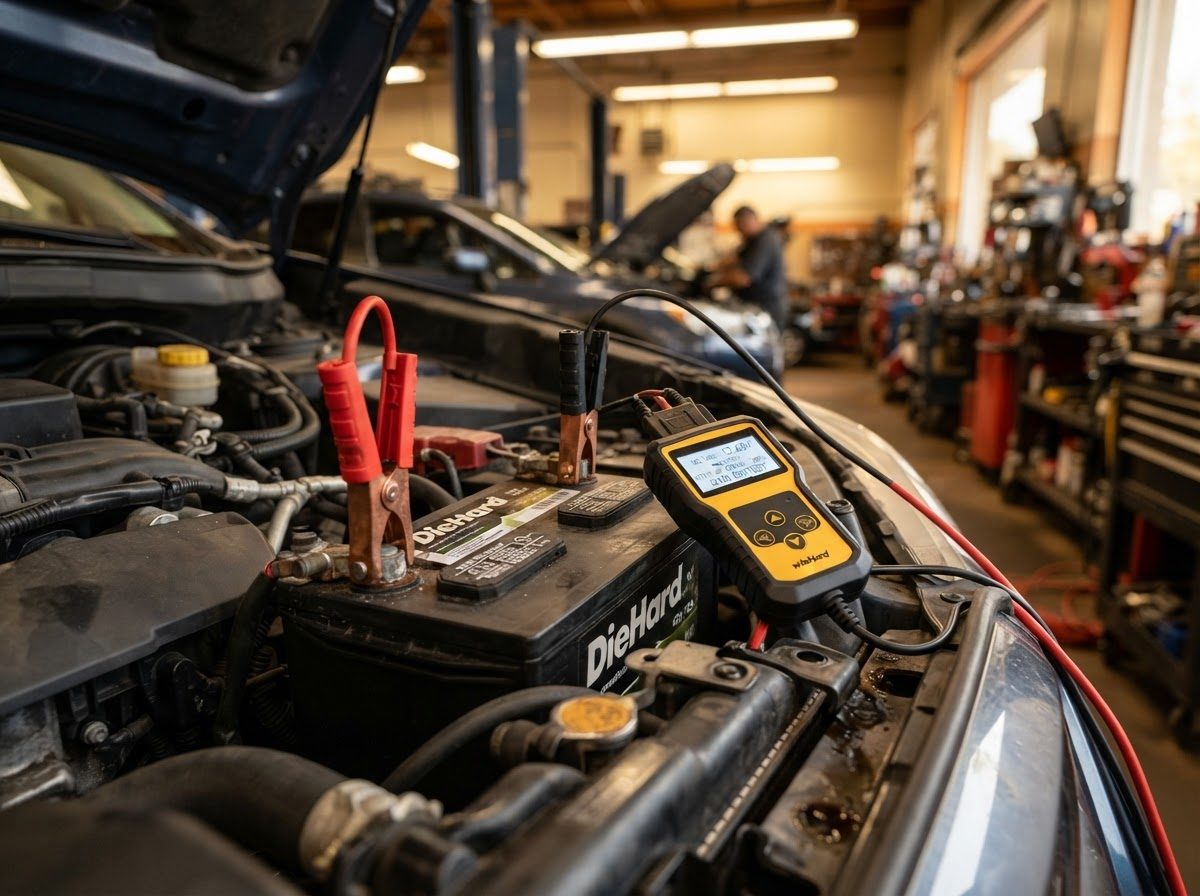
A successful jump-start tells us the battery was low. It doesn't prove the battery is the only problem. A weak battery, a charging-system fault, a poor connection, or a parasitic draw can all be the real cause — and any of them can leave you stranded again.
If you're unsure how to boost safely, call us. And after a boost, book a battery and charging-system test rather than assuming it's fixed.
Battery & jump-start safety
Connect positive to positive, negative to a clean engine ground — not the negative post directly.
Never let the cable clamps touch each other or the body.
If you see smoke, swelling, or smell rotten eggs, stop — battery gases can be dangerous.
After a boost, drive straight to the shop if you can — a failing charging system can leave you stranded again.
What happens during diagnosis?
Driver symptoms → battery & electrical checks → starting-system checks → scan/test where relevant → confirm fault → repair recommendation. Replacing parts based only on a guess can waste money.
Driver symptoms
You describe what happens when you turn the key.
Battery & electrical
We test voltage, connections, and power.
Starting-system checks
We test the starter and start circuit.
Scan & test
Fuel, ignition, engine-management as needed.
Confirmed fault
Testing — not a guess — confirms it.
Match your situation
Each card has useful guidance and an urgency label. Possible cause is not a confirmed diagnosis.
Nothing Happens When I Turn the Key
No sound at all can mean the battery is completely dead, a cable or connection failed, a fuse blew, or the ignition switch isn't sending power. We test power first, then work through the circuit.
Rapid Clicking
Usually a weak battery or poor connection. A boost may get you going, but testing confirms whether it's the battery, a connection, or a draw — not just the battery.
One Click but No Start
Can indicate a starter or starter-circuit fault — the solenoid engages but the motor won't turn. Don't keep cranking; it can overheat the starter.
Engine Cranks but Won't Start
Fuel, ignition, or engine-management causes are possible. Observation narrows the path, but systematic testing is needed to confirm — we don't guess.
Starts Then Dies
Can be fuel, a sensor, an immobilizer, or a charging issue. If it dies right after starting, drive minimally and book a diagnosis — it may leave you stranded.
Slow or Weak Cranking
A weak battery or a starter drawing too much can both cause a slow crank. We test both before recommending a part.
Car Starts With a Boost
A boost tells us the battery was low — but not why. A weak battery, a charging fault, a poor connection, or a draw are all possible. Book testing rather than assuming it's solved.
Dash Lights Are Dead
No dash lights usually means no electrical power reaching the system — battery, cable, fuse, or connection. Arrange testing if the vehicle stays inoperative.
Starting Problem Comes and Goes
An intermittent start can be a connection, a relay, a sensor, or a charging issue. It won't get more reliable on its own — book a diagnosis and describe when it happens.
Car Won't Start After Sitting
A vehicle that sat unused can lose battery charge over time, or develop a parasitic draw. A battery and charging-system test confirms the cause before you replace parts.
Clear decision guidance
Plain rules to help you decide. We don't overstate certainty — testing confirms the cause.
If the dash is completely dead when you turn the key
→ Check whether any electrical power appears at all. If nothing works, arrange battery and electrical testing — don't keep cranking.
If you hear rapid clicking
→ Battery voltage or electrical supply may be involved. A boost may start it, but testing confirms whether it's the battery, a connection, or a draw.
If the engine cranks normally but will not fire
→ The investigation goes beyond the battery. Fuel, ignition, or engine-management causes are possible — systematic testing is needed.
If the vehicle starts with a boost
→ BOOK testing rather than assuming the problem is solved. A weak battery, charging fault, poor connection, or draw can all be the real cause.
If you smell smoke, burning rubber, or see smoke
→ STOP — stop trying to start it and arrange assessment. An electrical or wiring issue can be a safety concern.
If it cranks slowly only on cold mornings
→ MONITOR — have the battery and charging system tested before it leaves you stuck.
Car won't start in Surrey? Bring it to Darcy's.
We're a proudly father-and-son owned independent repair shop in Surrey, BC. We test the battery, connections, starter, and charging system to find the root cause — and explain what we found before any work begins. We don't provide towing; if your vehicle can't be moved, you'll arrange that separately.
Call 604-599-1223Address
Unit 102 – 12465 82 Avenue
Surrey, British Columbia V3W 3E8
Phone
604-599-1223Hours
Mon–Fri: 9:00 AM – 5:30 PM
Saturday: 9:00 AM – 3:30 PM
Sunday: Closed
Car won't start questions, answered
Direct answers first. These are general explanations — testing confirms the actual cause for your vehicle.
A no-start can stem from the battery, starter, charging system, fuel, ignition, or engine-management issues. The sound your vehicle makes when you turn the key is a useful clue, but it doesn't confirm the cause — testing each system does. We test the battery, connections, starter, and charging system, then move to fuel and ignition if needed.
Ask the No-Start specialist
A floating specialist is available on this page (bottom-right, above the red questionnaire). It answers questions based only on this guide and verified Darcy facts — it never claims to diagnose your vehicle.
Look for the orange button in the corner.