Engine Diagnostics
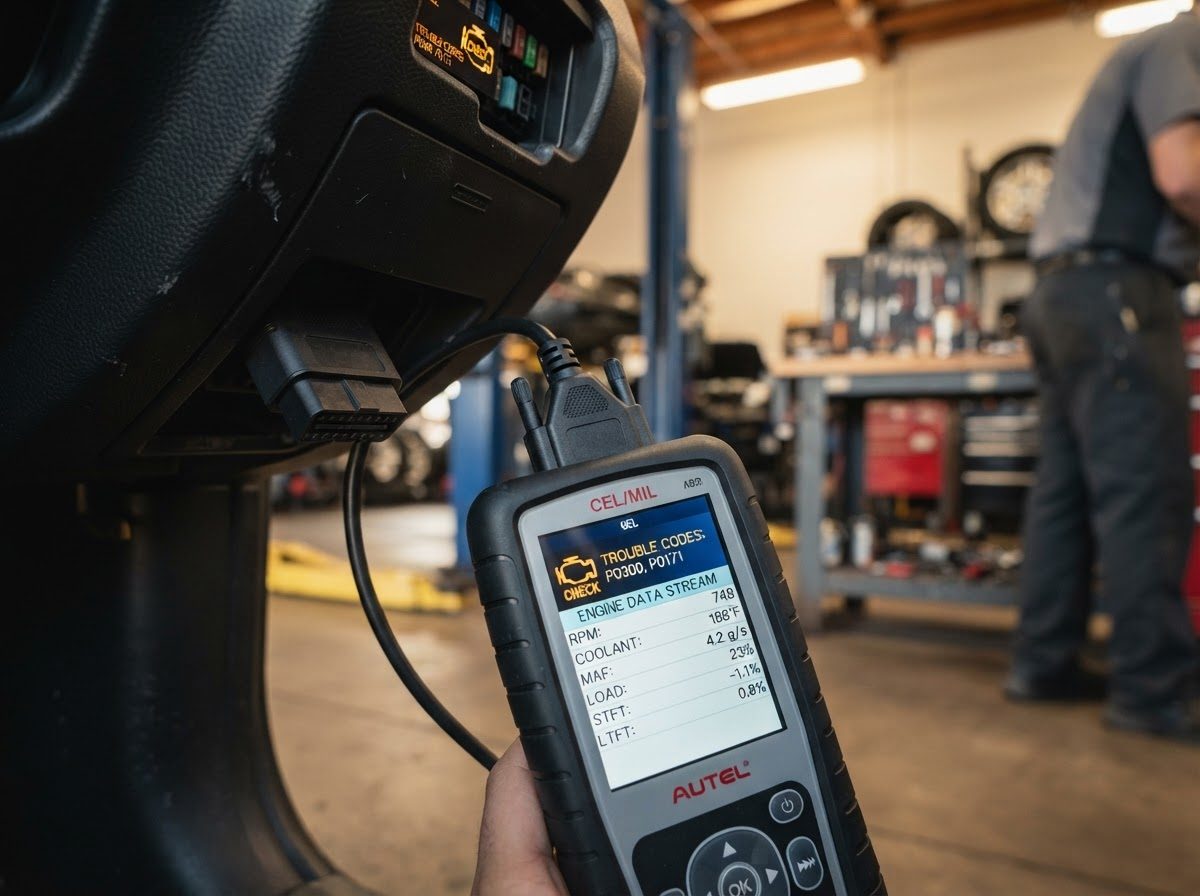
Check-engine lights and drivability issues require more than reading a code. Darcy's combines diagnostic data with hands-on testing to find the actual cause, not just the symptom — because a trouble code identifies a detected condition, not a confirmed failed part.
Common Symptoms
Check engine light on
The system detected a fault. We scan and test to find the cause.
Engine runs rough
A misfire, sensor, or fuel issue is possible. We diagnose the cause.
Stalling or hesitation
Fuel, ignition, or sensor issues can cause stalling or hesitation.
Reduced fuel economy
A sensor, fuel, or engine-management issue can reduce economy.
Failed emissions test
Often an emissions-related fault. We diagnose the cause.
Can I Drive With This?
STOP
Flashing check-engine light with shaking or major power loss — stop safely and arrange inspection or towing. Darcy's does not provide towing; customers arrange it separately.
DRIVE WITH CAUTION
Steady light with the vehicle otherwise feeling normal — cautious short-term driving may be possible while arranging diagnosis.
BOOK
Steady check-engine light, rough running, stalling, or reduced economy — book a diagnostic.
MONITOR
Light that comes and goes — book soon; intermittent still means a fault.
Possible cause is not a confirmed diagnosis. When in doubt, call us.
What Darcy's Checks
These are the items that may be inspected. We don't claim every component is always tested or replaced — we check what's relevant to your symptom.
- Full diagnostic scan for stored and pending codes
- Freeze-frame data (conditions when the code set)
- Live data (sensor readings while running)
- Ignition system (plugs, coils, wires)
- Fuel system (pressure, injectors)
- Airflow and vacuum system
- Emissions and O2 sensor operation
- Verification that the repair resolves the cause
How the Service Process Works
- 1
You tell us what the vehicle is doing and when.
- 2
We scan for codes and review freeze-frame and live data.
- 3
We test the relevant components to confirm the actual cause.
- 4
We explain what the code means and what we found.
- 5
We discuss options and let you decide.
- 6
After repair, we verify the fault is resolved. Work proceeds according to the shop's normal process.
Possible Causes & Repairs
These are categories of potential causes — not a confirmed diagnosis. We test to confirm the actual cause before recommending any repair.
Ignition fault
A misfire from worn plugs, a failing coil, or wiring.
Fuel-system issue
Injector, pump, or pressure problem.
Sensor reading outside range
A MAF, O2, coolant, or MAP sensor fault.
Emissions-related fault
EVAP, catalytic-converter efficiency, or O2-sensor issues.
Intake or vacuum leak
Unmetered air causing a lean condition.
Electrical or charging-related condition
A voltage or wiring issue affecting engine management.
Customer Education
Why a trouble code is not a diagnosis
A code identifies a detected condition or system — not a confirmed failed part. A misfire code doesn't always mean a bad coil; an O2 code doesn't always mean a bad sensor. Testing is needed to confirm the cause. Replacing the part named in a code without testing can waste money.
What a check-engine light means
The onboard computer detected a fault or abnormal reading and stored diagnostic information. The light tells you a problem exists — it doesn't by itself identify the failed part. We scan and test to find the actual cause.
Flashing vs. steady check-engine light
A steady light means a fault is present. A flashing light is more urgent — it often indicates a misfire severe enough to damage the catalytic converter. Reduce engine load and stop safely rather than continuing normal driving.
What to tell your mechanic before a diagnostic
When the light came on, whether it's steady or flashing, how the vehicle feels, any noise or smell, whether power changed, and whether it started after fueling or service. Your description narrows the investigation.
Why the light can come back after being cleared
Clearing a code doesn't fix the problem — it just resets the light. If the underlying cause is still there, the light comes back. We verify the repair resolves the cause, not just the code.
Engine Diagnostics in Surrey, BC
Darcy's Auto Service is a proudly father-and-son owned independent repair shop at Unit 102 – 12465 82 Avenue, Surrey, BC V3W 3E8. We've served Surrey drivers for 28+ years. Call us and describe what your vehicle is doing — we'll help you understand what may be happening and what your next step should be.
Address
Unit 102 – 12465 82 Avenue, Surrey, BC V3W 3E8
Phone
604-599-1223Hours
Mon–Fri 9AM–5:30PM
Sat 9AM–3:30PM · Sun Closed
Frequently Asked Questions
Direct answers about engine diagnostics.
What does a check-engine light mean?
The onboard computer detected a fault or abnormal reading and stored diagnostic information. The light tells you a problem exists — it doesn't by itself identify the failed part. We scan and test to find the actual cause.
Does a trouble code tell you exactly what part is bad?
No. A code identifies a detected condition or system, not a confirmed failed part. Testing is needed to confirm the cause. Replacing the part named in a code without testing can waste money.
Should I clear the code myself?
Clearing a code doesn't fix the problem — it just resets the light. If the cause is still there, the light comes back. We verify the repair resolves the cause, not just the code.
How is a check-engine problem diagnosed?
We scan for codes, review freeze-frame and live data, then test the relevant components to confirm the actual cause. A code is the starting point, not the answer.
Why did the light come back after being cleared?
Clearing a code doesn't fix the underlying cause. If the problem is still there, the light returns. We verify the repair resolves the cause.
Can a gas cap trigger the light?
Yes. A loose or faulty gas cap can trigger an EVAP-related code. It's one of the simpler causes — but not the only one. We test to confirm.
Will the light turn off by itself?
Sometimes, if the condition resolves. But the underlying cause may still need attention. Don't ignore a light that comes and goes — intermittent still means a fault.
Why is the light on if the car feels fine?
The system detected a fault even if the vehicle feels normal. Some faults affect emissions or efficiency without an obvious drivability change. Have it diagnosed rather than ignoring it.
What is an engine misfire?
A misfire is when one cylinder doesn't fire properly — from fuel, ignition, or air issues. It can cause rough running, shaking, or a flashing light. We diagnose the cause.
What should I tell the repair shop before a diagnostic?
When the light came on, whether it's steady or flashing, how the vehicle feels, any noise or smell, whether power changed, and whether it started after fueling or service.