
Check Engine Light On in Surrey? Start Here.
A check-engine light can have many causes — the first priority is determining urgency based on how your vehicle is behaving. Tell us what's happening and we'll help you understand what may be going on and what your next step should be.
Is your check-engine light flashing or steady?
That single question changes the urgency. A flashing light can indicate a more urgent problem and should be treated differently from a steady light.
Flashing light
Often a severe misfire. Unburned fuel can damage the catalytic converter. Reduce engine load and stop safely rather than continuing to drive. Treat it as urgent.
Steady light
A fault was detected. If the vehicle feels normal, cautious short-term driving may be possible — but book a diagnosis soon. New severe symptoms raise the urgency.
Tell us what your vehicle is doing
One question at a time. The result gives you an urgency level and a next step — it never claims to diagnose your vehicle. Testing confirms the actual cause.
Check Engine Light Guide
One question at a time · never a diagnosis
Is your check-engine light flashing or steady?
A prominent decision aid — not buried copy
Three situations, three different answers. Safety comes before conversion.
Continued driving may create unnecessary risk
A flashing light with shaking, overheating, or exhaust fumes in the cabin. Stop safely and arrange diagnosis or towing before driving further.
Cautious short-distance driving may be reasonable
A light with loss of power, a smell, or a flashing light without other symptoms. Drive minimally to the nearest safe stop and book a diagnosis right away.
Schedule an inspection even if it feels normal
A steady light with no other symptoms. The fault is still real — book a diagnostic soon rather than ignoring it.
The light means a fault was found — not which part failed.
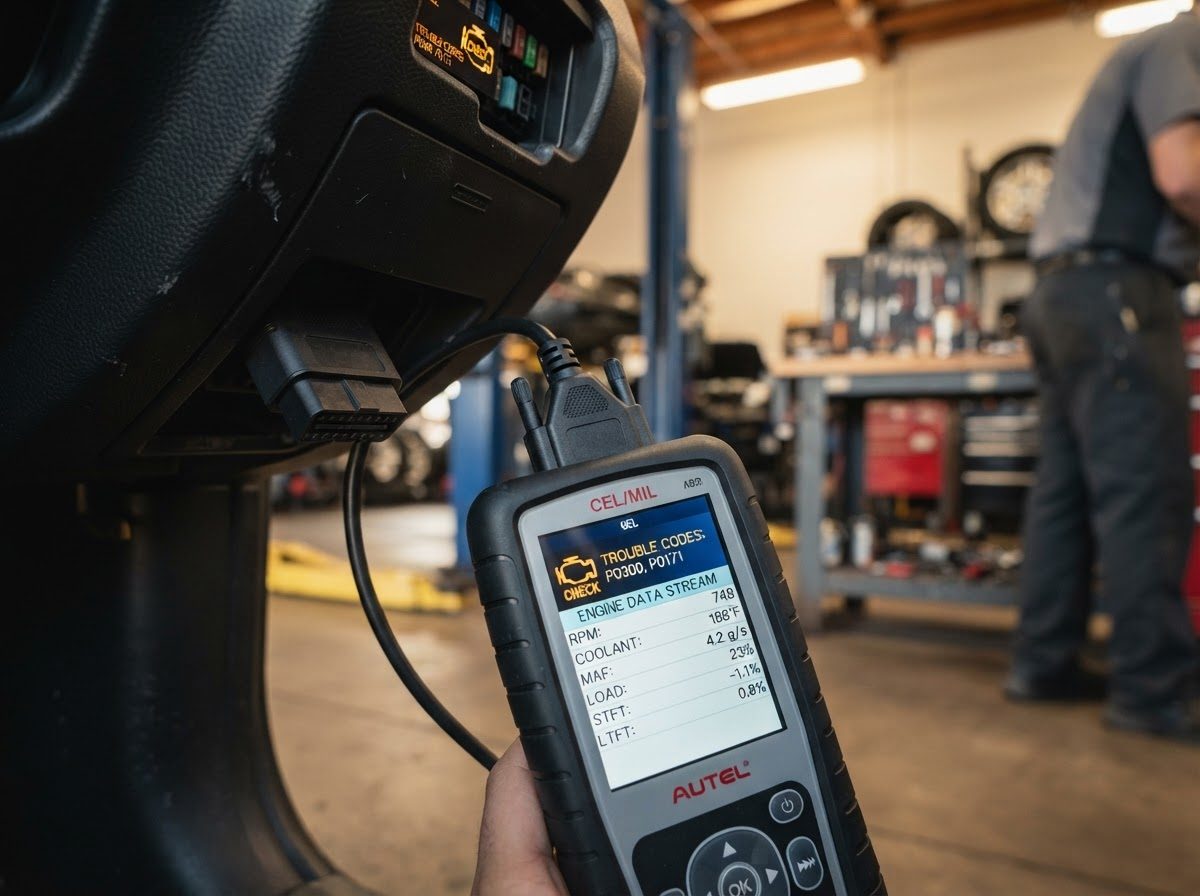
Your vehicle's onboard computer watches dozens of sensors and components. When something falls outside expected parameters, it stores a diagnostic trouble code and turns on the light. The light tells you a problem exists — it doesn't name the failed part.
A code scan tells us which system flagged the fault; testing confirms the actual cause. That's why a scan is a starting point, not a conclusion.
Steady vs flashing — at a glance
- BOOK
Steady: a fault was detected. Diagnose soon; cautious short-term driving may be possible if it feels normal.
- STOP
Flashing: often a severe misfire. Can damage the catalytic converter. Reduce load and stop safely.
Common categories — not your confirmed diagnosis
These are general categories that can trigger the light. We test to confirm the actual one before recommending any repair.
Ignition / misfire
Spark, coil, or fuel delivery issues can cause incomplete combustion.
Fuel / air mixture
The mixture ratio fell outside the expected range the computer targets.
Emissions-related faults
Components in the evaporative or exhaust emissions system flagged a reading.
Sensor out of range
A sensor like the oxygen or mass airflow sensor reported an abnormal value.
Intake / vacuum issues
An air leak or vacuum leak can change how the engine runs and is metered.
Electrical / charging
Voltage or charging-system conditions can affect sensors and modules.
What information should the driver gather?
The details you give us change how fast we find the problem. You don't need technical words — plain description is perfect.
- Flashing or steady?
- When the light appeared
- How the vehicle feels
- Any noise
- Any smell
- Whether power changed
- Any other warning lights
- Recent fuel or service
What happens during diagnosis?
Symptoms → scan information → inspection/testing → confirmed cause → repair recommendation. Reading a code is not the same as completing a diagnosis.
Vehicle symptoms
You describe what's happening.
Scan information
We read the code and freeze-frame.
Inspection & testing
We test each possible cause.
Confirmed cause
Testing — not the code — confirms it.
Repair recommendation
We explain before any work begins.
Match your situation
Each card has useful guidance and an urgency label. Possible cause is not a confirmed diagnosis.
Check Engine Light Flashing
Often a severe misfire. Reduce engine load and stop safely. Continued driving can damage the catalytic converter.
Check Engine Light Steady
A fault was detected. If it feels normal, cautious short-term driving may be possible — book a diagnosis soon.
Check Engine Light + Rough Running
Shaking or rough idle with the light points to a misfire or running issue. Treat a flashing light as urgent.
Check Engine Light + Loss of Power
Reduced power can mean the engine is in a protective mode. Drive minimally and book diagnosis right away.
Check Engine Light + Strange Smell
A sweet smell may be coolant; exhaust fumes in the cabin are a safety concern. Stop and arrange assessment.
Check Engine Light + Overheating
Overheating can cause serious engine damage. Stop safely, shut the engine off, and don't open a hot system.
Check Engine Light After Fueling
A loose or faulty fuel cap is one possibility. If the cap is snug and the light stays, book a diagnosis.
Check Engine Light, No Other Symptoms
The fault is still real even if it feels fine. Book a diagnostic soon rather than ignoring it.
Clear decision guidance
Plain rules to help you decide. We don't overstate certainty — testing confirms the cause.
If the light is flashing AND the engine is shaking
→ STOP — seek professional guidance before driving further.
If the light is steady and the vehicle feels normal
→ BOOK an inspection rather than ignoring it.
If the light is flashing with no other symptoms
→ DRIVE WITH CAUTION to the nearest safe stop, then book diagnosis.
If you smell exhaust inside the cabin
→ STOP — carbon monoxide is dangerous. Stop using the vehicle.
If the light came on right after refueling
→ MONITOR — check the fuel cap is clicks-tight; if the light stays, book it.
If the temperature gauge is climbing
→ STOP — overheating can cause serious damage. Stop safely and shut off.
A check-engine light in Surrey? Bring it to Darcy's.
We're a proudly father-and-son owned independent repair shop in Surrey, BC. We explain what your check-engine light means, what may be causing it, and what your next step should be — before any work begins.
Call 604-599-1223Address
Unit 102 – 12465 82 Avenue
Surrey, British Columbia V3W 3E8
Phone
604-599-1223Hours
Mon–Fri: 9:00 AM – 5:30 PM
Saturday: 9:00 AM – 3:30 PM
Sunday: Closed
Check Engine Light questions, answered
Direct answers first. These are general explanations — testing confirms the actual cause for your vehicle.
It depends on how the vehicle is behaving. A steady light with normal driving may allow cautious short-term driving while you arrange a diagnosis. A flashing light, shaking, overheating, or exhaust fumes mean stop driving and arrange diagnosis or towing. When in doubt, call us and describe what's happening.
Ask the Check Engine Light specialist
A floating specialist is available on this page (bottom-right, above the red questionnaire). It answers questions based only on this guide and verified Darcy facts — it never claims to diagnose your vehicle.
Look for the orange button in the corner.